Dynamic Personalization with AI & CDP: Transforming Content and Reviews Based on Real-Time Search Intent
Personalization in 2026: Beyond Simple Rules
Showing every visitor to your website the exact same headings, product descriptions, and reference reviews is a missed conversion opportunity in the 2026 martech landscape.
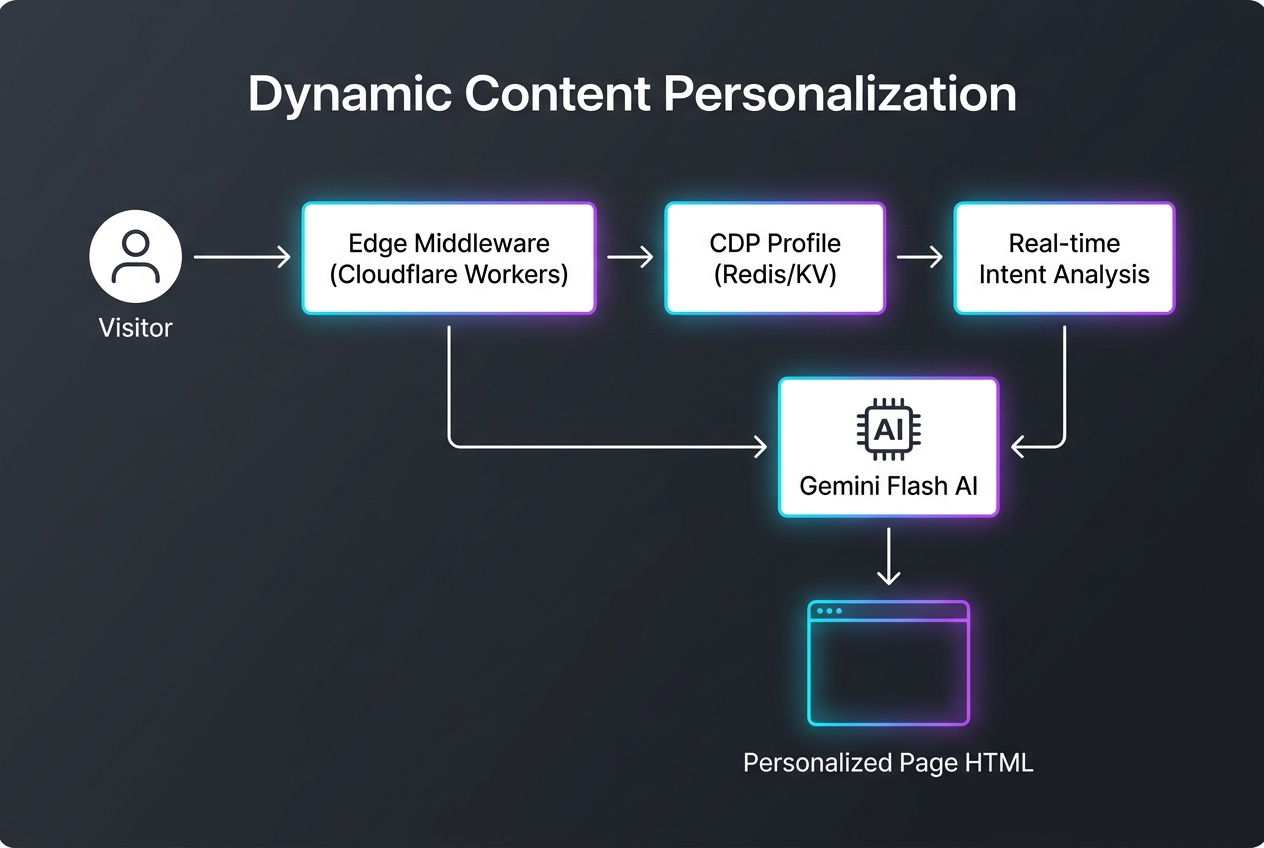
Traditional personalization relied on static rules, such as "If a user is from New York, display Heading X." Today, Artificial Intelligence (AI) and Customer Data Platforms (CDPs) allow us to merge a visitor's historical profile data with their real-time search intent to reconstruct the entire page in milliseconds.
In this article, we explain how to build an "AI + CDP-Powered Dynamic Content and Review Personalization" architecture quickly, efficiently, and without breaking the bank.
The Foundation: Marrying Historical Profiles with Real-Time Intent
For truly effective personalization, we must merge two core data sources:
- CDP Profile (Historical Behavior): What pages the visitor previously viewed, their basket size, industry (if B2B), or interests (collected into a unified profile, e.g., on Meiro CDP).
- Real-Time Search Intent: Which ad campaign (UTM parameters), organic search term, or referring source brought the visitor to the site.
Real-World Scenarios: E-Commerce & OTA (Online Travel Agencies)
1. In E-Commerce and Retail:
- Visitor A (Sustainability-Oriented): Arrives via a Google search for "premium sustainable sneakers." Their CDP profile indicates they have previously browsed eco-friendly materials and products.
- Personalized Page: The product page displays the headline "Eco-Friendly and Sustainable Premium Footwear." In the review section, other customers' feedback highlighting "recyclability, organic texture, and ecological certifications" is prioritized at the top.
- Visitor B (Price-Sensitive / Cart Abandoner): Search-engine referred while hunting for discount coupons. Labeled in the CDP as a "price-sensitive segment with an active abandoned cart."
- Personalized Page: The exact same product page opens with the headline "Get an Extra 15% Off Your Cart + Free Shipping." Testimonial reviews detailing "price-to-performance value, durability, and fast shipping" are displayed first.
2. In OTA (Online Travel / Tourism):
- Visitor C (Family Vacation Planner): Arrives via a search for "Bodrum kid-friendly pool villa." Matched in their CDP profile as a parent of two children.
- Personalized Page: The villa detail page shifts to "Secure Family Villas with Dedicated Kids' Play Areas." Testimonial reviews focusing on "kids club quality, hygiene, high-chairs, and baby cot availability" are highlighted at the top.
- Visitor D (Business Traveler): Searching Google for "business hotel near Levent weekday stay."
- Personalized Page: The hotel page opens with the headline "Quiet & Comfortable Rooms in the Financial District for Your Business Trips." Customer feedback discussing "high-speed Wi-Fi reliability, room desk ergonomics, and peaceful environment" is prioritized.
Cost-Effective & High-Speed Solutions: Edge Computing
When setting up this architecture, the two main concerns are usually page load speed (LCP/Performance) and high AI API costs. Here are the practical optimization techniques we use to overcome these barriers:
1. Processing at the Edge (Zero Latency)
Performing personalization in the browser (client-side JavaScript) causes page layout shifts (flickering) and degrades SEO performance.
- The Solution: We move the page rendering logic to Cloudflare Workers or Next.js Edge Middleware. The visitor's CDP profile is queried in milliseconds from an in-memory key-value store (e.g., Redis or Cloudflare KV). The page HTML is assembled on the fly before reaching the user's browser.
2. Smart Caching and Hybrid AI
Hitting a large language model (LLM) live on every single page view is slow and expensive.
- The Solution: We map search intents and profile segments to predefined templates (e.g., combinations of 5 main buyer personas and 10 search intents). The AI generates corresponding headlines and review variations once in the background, caching them at the Edge. When a visitor arrives, the pre-generated template is served in milliseconds. If a highly unique query is detected, a lightweight, fast model like Gemini Flash is called live.
Let's Build This Together
At ONMARTECH, we have hands-on experience designing and deploying dynamic personalization architectures. Instead of selling bloated, expensive enterprise software suites, we optimize your existing CDP data structure (such as Meiro) and Edge architecture to turn your website into an intelligent, conversion-focused engine in just 2 to 3 weeks.
If you are ready to design a dynamic personalization flow that drives real ROI, you can schedule a session on our Contact Page or reach out to us directly at info@onmartech.com.
Recommended Reading
The Evolution of Quanta SDK: From Zero-Dependency Python Core to Apple Silicon Metal, PyTorch Autograd, and FTQC Architecture
The engineering journey from a zero-dependency pure Python quantum core to 23 Model Context Protocol (MCP) tools, Apple Silicon Metal/MLX zero-copy acceleration, PyTorch differentiable layers, and 2026 dual-track fault-tolerant quantum computing (FTQC / qLDPC).
Read More →The Evolution of Metabase AI Assistant: From Naive Text-to-SQL to a 143-Tool Enterprise MCP BI Engine
The engineering journey from a fragile natural language SQL prototype to an enterprise Model Context Protocol (MCP) server featuring dbt semantic layer routing, autonomous self-healing queries, 24-column dashboard layout architecting, and governance-first business memory.
Read More →